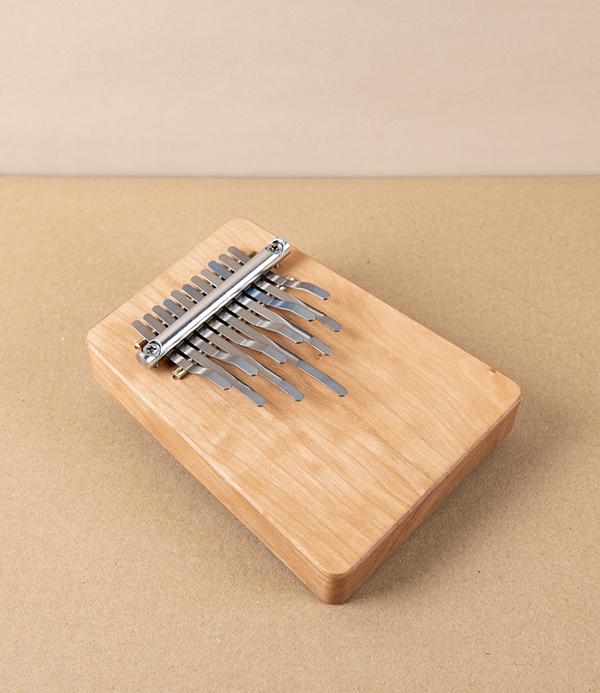
A beautiful Kalimba with 11 tines made by Hokema in the small town of Walsrode in Lower Saxony. The tines are arraanged in two rows, the lower of which are tuned to a G major scale, these notes make it perfect for intuitive playing as well as for a number of well-known tunes. Relaxing and meditative, and simple enough for anyone to pick up and make beautiful music with. While the Kalimba has a short history dating back only to its export by ethnomusicologist Hugh Tracey in the late 50's, the instruments forefather, the Mbira, has a rich 3000 year history, originating in present-day Cameroon and composed entirely of plant based materials with bamboo tines. Those with metal tines date back approximately 1300 years, and are thought to have emergered during the Zambezi valley's Iron Age. The Mbira of the African diaspora have too many tunings to list here, all vastly different from the scales more commonly associated with the Western tradition. This Kalimba however, tuned to A440, harmonises perfectly with many modern instruments though it is especially beautiful paired with the voice — we recommend making note of a relevant saying, "A Kalimba without singing is like rice without beans."
This Kalimba has been hand-made and tuned by Hokema of Germany, an experienced and respected maker founded in 1965. The tines are tuned from left to right as follows, g'' - a' - e'' - d' - c'' - g - d'' - g' - f#'' -b' - a''. The reed arrangement is such that the shorter and higher reeds are bent so that their ends are at a higher level than those of the long reeds, so that they can easily be reached by the thumbs. When playing the notes from low to high, the five long reeds are first plucked alternately from the middle outwards with both thumbs — the right thumb starts on reed number 6 — then the six short reeds, also from the middle outwards. The left thumb starts on reed number 5.
For tonal reasons these tines are not made of stainless steel, but rather of a specially coated spring steel — this coating will protect the steel from corrosion, but once the coating wears away rust can be difficult to avoid. Care therefore should be taken to protect the coating, and, as its natural combatant is found within the oils on the skin and fingertips, it is recommended that after every play session the tine's surfaces are wiped with a dry, soft cotton cloth — without disinfectants, and not microfibre! Additionally, high humidity and heat is not good for the instrument, so be wary of the environment it is kept in.
This Kalimba has 11 tines, mounted on a base of oiled American cherry, measuring 140mm x 105mm x 35mm.